Cooling Methods for High-Performance Motors
Explore air, liquid, and advanced cooling techniques to boost efficiency, extend lifespan, and prevent thermal runaway in high-performance motors.
Thermal Fundamentals
High-performance motors generate significant heat, and effective thermal management begins with understanding the heat sources and the path that heat takes to exit the machine. Copper losses from I2R in the windings, core losses in the laminations, and mechanical losses from bearings and windage all contribute to hot spots that elevate temperature rise. The objective is to minimize thermal resistance from the windings to the housing and finally to the ambient or a coolant interface, while keeping heat flux within safe limits for materials and insulation. Engineers model the conduction path through slot liners, impregnation resin, stator teeth, and the frame, and they account for the thermal effects of mounting surfaces and fasteners. Design must balance continuous versus peak duty cycle, since brief bursts may be permissible if the thermal mass can absorb them without exceeding limits. Ambient conditions, altitude, and enclosure style alter convection performance, making it essential to align the thermal design with the motor's workload, installation, and maintenance practices to sustain efficiency and reliability.
Forced-Air Cooling
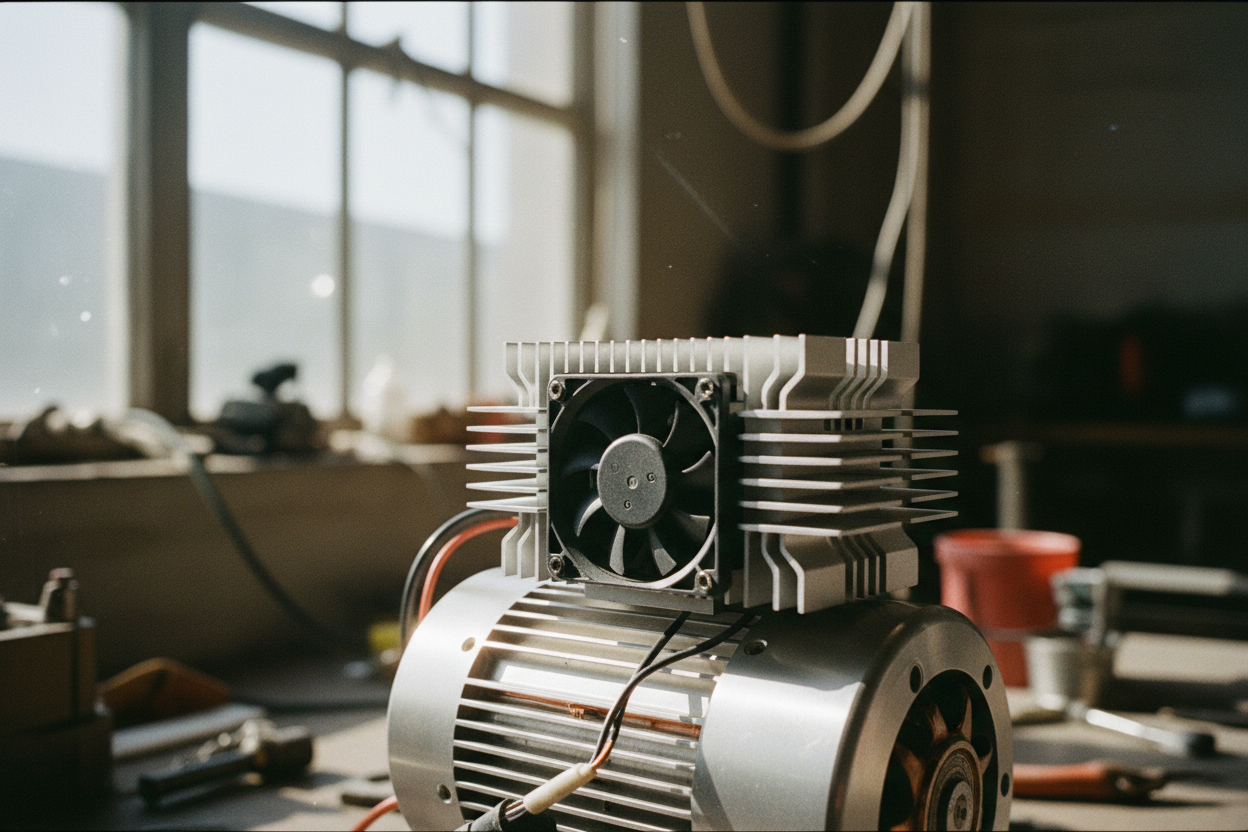
Forced-air cooling remains a versatile method for many motors thanks to simplicity and cost-effectiveness. A fan or blower pushes air over finned housings, end bells, and dedicated shrouds to raise convective heat transfer and reduce surface thermal resistance. Fin geometry matters: taller fins increase surface area, while optimized thickness, spacing, and orientation promote turbulence without causing excessive pressure drop or debris buildup. Directed ducting can focus airflow across hot spots like end turns and power electronics mounted to the motor frame. Designers also consider acoustic noise, vibration from rotating fans, and the impact of ingress protection on airflow. Filters and screens help control fouling but add resistance, so periodic cleaning is vital for stable performance. Variable-speed fans paired with temperature feedback enable proportional cooling, lowering noise and parasitic losses during light loads while providing headroom for high demand. When space is limited, compact crossflow blowers or radial fans can maintain airflow uniformity, ensuring air-cooled packages perform reliably under aggressive duty cycles.
Liquid Cooling Circuits
When heat density rises, liquid cooling unlocks high thermal performance with compact packaging. A cooling jacket integrated around the stator or a cold plate attached to the housing extracts heat via a pumped loop. Common coolants include water-glycol blends for broad temperature ranges and dielectric fluids where electrical isolation is essential. Flow rate, pressure drop, and pump sizing determine the heat transfer coefficient, while proper routing minimizes stagnant zones and ensures even temperature distribution. Materials selection is critical to avoid galvanic corrosion, so designers align aluminum, copper, and stainless components with suitable inhibitors. To prevent cavitation and entrained air, systems use careful fill procedures, deaeration features, and compliant reservoirs. Quick disconnects aid serviceability but must be rated for thermal cycling and vibration. Sensors at inlet and outlet provide temperature and flow data for closed-loop control, allowing precise regulation and protection against blockage or pump failure. With the right plumbing, seals, and maintenance practices, liquid cooling supports sustained continuous ratings while preserving compact, quiet motor assemblies.
Direct and Oil-Based Cooling
For extreme power density, direct cooling targets the heat at its source. Oil spray or dielectric fluid directed onto end turns, rotor surfaces, or bearings dramatically lowers thermal resistance by reducing conduction distances and boosting local convection. In some architectures, hollow shafts route fluid through the rotor, or stator slot cooling incorporates embedded tubes or channels adjacent to windings. The effectiveness depends on uniform coverage, controlled flow paths, and reliable sealing that prevents leaks and contamination. Designers must manage churning losses and ensure oil return paths avoid pooling that can aerate the fluid or starve critical regions. High-conductivity impregnation resins and potting compounds enhance conduction from copper to cooled surfaces, while compatible slot liners and adhesives maintain electrical integrity. Bearing life benefits from correct lubricant temperature, but fluid selection should match insulation systems and magnet limits. Filtration and monitoring maintain cleanliness, preserving small clearances and preventing abrasive wear. When executed well, direct and oil-based strategies deliver outstanding thermal headroom with consistent, repeatable performance under rapid load transients.
Advanced Thermal Technologies
Cutting-edge methods expand the cooling toolkit for motors pushed to the limit. Heat pipes and vapor chambers move heat with minimal temperature gradient, spreading hot spots from windings or inverters to larger, more effective exchangers. Phase-change materials can buffer short bursts by absorbing heat during transitions, smoothing thermal transients for applications with intermittent peaks. Microchannel and jet-impingement plates achieve very high local heat transfer, ideal for compact frames where traditional jackets are insufficient. Additive manufacturing enables complex conformal channels, lattices, and integrated heat spreaders that shorten conduction paths and reduce mass. While thermoelectric coolers can stabilize temperatures precisely, they add power draw and are best reserved for niche needs. To fully exploit these technologies, robust thermal interface materials ensure intimate contact, and surface finishes are controlled to lower contact resistance. Successful designs pair advanced hardware with model-based control, predicting thermal behavior and adjusting coolant flow, fan speed, and torque limits before temperatures approach critical thresholds.
Design, Validation, and Maintenance
Durable cooling strategies for high-performance motors rely on rigorous modeling, validation, and upkeep. Early-stage CFD and lumped-parameter thermal networks guide geometry choices, fin layouts, channel routing, and TIM selection. Prototypes instrumented with RTDs, thermocouples, or fiber-optic sensors map hot spots under realistic duty cycles, revealing gaps between prediction and reality. Engineers define derating curves that tie torque to coolant or ambient temperatures, safeguarding insulation class and magnet integrity. Integration with power electronics matters, since inverter losses add heat and switching profiles can be tuned to moderate copper and iron losses. Maintenance plans address fin cleaning, filter replacement, coolant testing, and seal inspection, preventing the drift in performance caused by fouling, evaporation, or corrosion. Condition monitoring and predictive maintenance track temperature trends, bearing health, and pump or fan operation, flagging degradation before it limits uptime. By treating cooling as a system-level discipline spanning design, control, and service, teams achieve stable efficiency, repeatable performance, and long service life in demanding motor applications.