Direct Drive vs Geared Motors: Pros and Cons
Weigh precision, torque density, efficiency, noise, and maintenance to choose between direct drive and geared motors for your application.
Foundations of Motor Architectures: In the world of motors, two dominant architectures shape how machines deliver motion: direct drive and geared motors. A direct drive couples the motor rotor straight to the load with no intermediate gear train. This removes gear mesh losses and backlash, producing mechanical simplicity, precise torque transmission, and instant reversals. A geared motor, by contrast, combines a compact electric motor with a reduction stage that multiplies output torque and reduces speed, allowing a smaller prime mover to handle heavier loads. The core trade-off rests on simplicity versus multiplication: direct drive favors minimal parts and high fidelity, while gearing unlocks torque density in tight packages. Designers must weigh how each approach affects efficiency, responsiveness, and integration. When application demands emphasize smoothness, low maintenance, and accurate positioning, direct drive often leads. When constraints call for high torque from a small frame, variable load profiles, or right-angle packaging, geared solutions provide the flexibility and mechanical leverage to meet the brief.
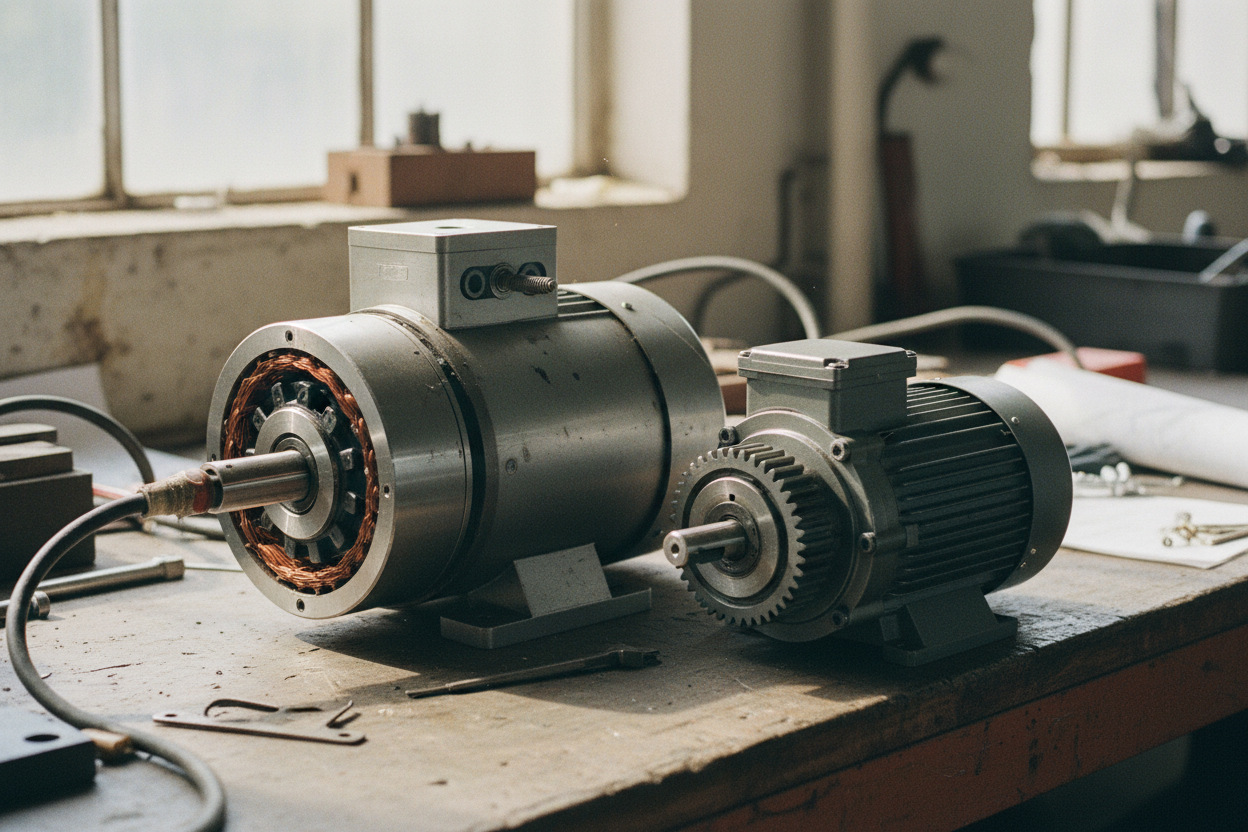
Torque, Speed, and Efficiency Trade-offs: Torque and speed are two sides of the same mechanical coin. A gearbox introduces a reduction ratio that lowers speed to raise torque at the output shaft, enabling modest motors to move significant loads. This advantage is tempered by efficiency losses from gear meshing, seals, and bearings that scale with load and speed. Direct drive avoids those parasitic losses and can deliver high continuous torque with excellent backdrivability, making systems feel responsive and controllable. However, to match the output torque of a geared unit, a direct drive often needs greater diameter, higher pole count, and optimized thermal paths to maintain power density. Geared motors excel in intermittent high-torque tasks where short bursts are common, while direct drive shines in steady, precise motion where smooth low-speed operation and torque linearity matter. The best choice hinges on duty cycle, acceptable losses, and whether the application prioritizes top efficiency or compact torque multiplication.
Noise, Vibration, and Smoothness: Acoustic and dynamic behavior often determine perceived quality in motors. Direct drive typically leads on NVH performance because there is no gear whine, no tooth meshing frequencies, and minimal cumulative runout. With the right electromagnetic design, it offers low cogging and smooth torque, especially when paired with sinusoidal commutation, careful slot-pole selection, and high-resolution sensing. Geared motors, while capable of precise output, introduce backlash, tooth engagement dynamics, and lubricant shear that can elevate vibration and tonal noise under load. Modern gear profiles, improved surface finishes, and helical gears help, as do damping and isolation mounts in the housing. At very low speeds, direct drive often feels buttery and continuous, a key benefit for inspection stages, camera gimbals, and collaborative mechanisms. Geared systems can approach this smoothness with preload, tight tolerances, and microstepping or advanced control, but maintaining that refinement over time requires attention to wear, lubrication, and assembly quality.
Size, Weight, and Packaging: Packaging constraints regularly steer the decision between architectures. Geared motors compress high torque into a small footprint, offering inline or right-angle layouts that thread through tight spaces. They allow flexible shaft placements and can incorporate hollow-shaft outputs, brakes, and encoders in compact stacks. Direct drive often needs larger diameter or thickness to meet torque targets, yet that increase can simplify the overall machine by removing the gearbox, couplings, and alignment features. In applications where a wide, flat pancake form factor is acceptable, direct drive can deliver exceptional low-speed torque with minimal height. For mobile or weight-sensitive designs, geared options can reduce motor mass while meeting load needs, though additional transmission components may offset gains. The right answer depends on how space is measured: by volume, envelope shape, or integration complexity. Sometimes a physically larger direct drive ends up lighter and simpler at the system level, trimming mounts, shafts, and adapter hardware.
Durability, Maintenance, and Reliability: Reliability hinges on the number of wear interfaces. Direct drive has fewer moving parts, minimizing failure points tied to lubrication, backlash growth, and seal degradation. This often translates to long life with minimal upkeep, provided the motor is thermally managed and protected from contamination. Geared motors carry additional elements that age: gears, bearings, and lubricants. Under shock loads or misalignment, teeth and bearings experience concentrated stress, which can erode accuracy and raise noise over time. Proper selection of gear materials, heat treatment, and lubrication regime is crucial to longevity. Duty cycle matters too: continuous service at elevated torque favors direct drive simplicity, while intermittent peaks may suit geared reductions if temperature and load spectrum are controlled. In safety-critical contexts, direct drive's backdrivability and reduced compliance aid fault response, whereas geared systems may need clutches, torque limiters, or overload protection to safeguard both the transmission and the load.
Control, Precision, and User Experience: Control strategy shapes how a motor feels and performs. Direct drive excels in precision because there is no gear backlash to hide or compensate, making closed-loop control straightforward and responsive. With a high-resolution encoder and field-oriented control, it delivers crisp torque at near-zero speed, enabling fine positioning and gentle human interaction. Geared motors can achieve excellent accuracy too, but controllers must handle compliance, friction, and stiction in the transmission. Techniques like feedforward, friction compensation, PID tuning with anti-windup, and backlash pre-compensation help tame these effects. For holding positions under load, gearing provides high holding torque with modest current, reducing heat in static conditions. Direct drive can hold using controlled torque but may draw more current unless aided by brakes. From a user perspective, direct drive systems often feel smoother and more transparent, while geared systems deliver muscle and stiffness that can be tuned through ratio selection and servo gains.
Cost, Applications, and Selection Checklist: The economics of motors extend beyond purchase price to total cost of ownership. Direct drive can reduce parts count, downtime, and maintenance, while boosting efficiency that lowers energy spend in continuous duty. Geared motors frequently win on upfront price for a given output torque and may simplify the bill of materials when power electronics or encoders can be smaller. Application patterns provide guidance: for collaborative robots, precision stages, turntables, and instruments where smoothness, repeatability, and low noise dominate, direct drive is compelling. For conveyors, mixers, hoists, mobility drives, and general automation that demand torque multiplication from compact frames, geared solutions are often optimal. Make a short checklist: load torque and speed profiles, duty cycle and thermal headroom, NVH limits, precision and backlash tolerance, packaging constraints, serviceability access, safety and backdrivability needs, and energy costs over life. Map these to architecture strengths to choose a motor path that is efficient, robust, and scalable.