Motor Controllers and Drivers: Getting Smooth, Precise Motion
Learn how motor controllers and drivers work together—PWM, H-bridges, microstepping, and PID feedback—to deliver smooth, precise motion in machines.
Smooth Motion Fundamentals — Achieving smooth, precise motion starts by distinguishing the motor controller from the driver. The controller interprets commands, builds a trajectory, and closes the loop on position, speed, or torque. The driver supplies power to the windings, converting logic-level intent into controlled current using PWM, current regulation, and the correct commutation scheme. Smoothness is won by managing torque generation, not just spinning a shaft. That means reducing static friction effects, avoiding deadband, and shaping acceleration with ramps to prevent mechanical shock. Precision depends on stable timing, adequate resolution, and clean feedback signals, while the driver must enforce current limits to protect both the motor and the supply. The controller may add filters, dither, or feedforward to tame friction and backlash. Together, a well-tuned controller and a robust driver create consistent, low-ripple torque, enabling quiet motion, accurate positioning, and repeatable results across the broad family of motors used in automation and robotics.
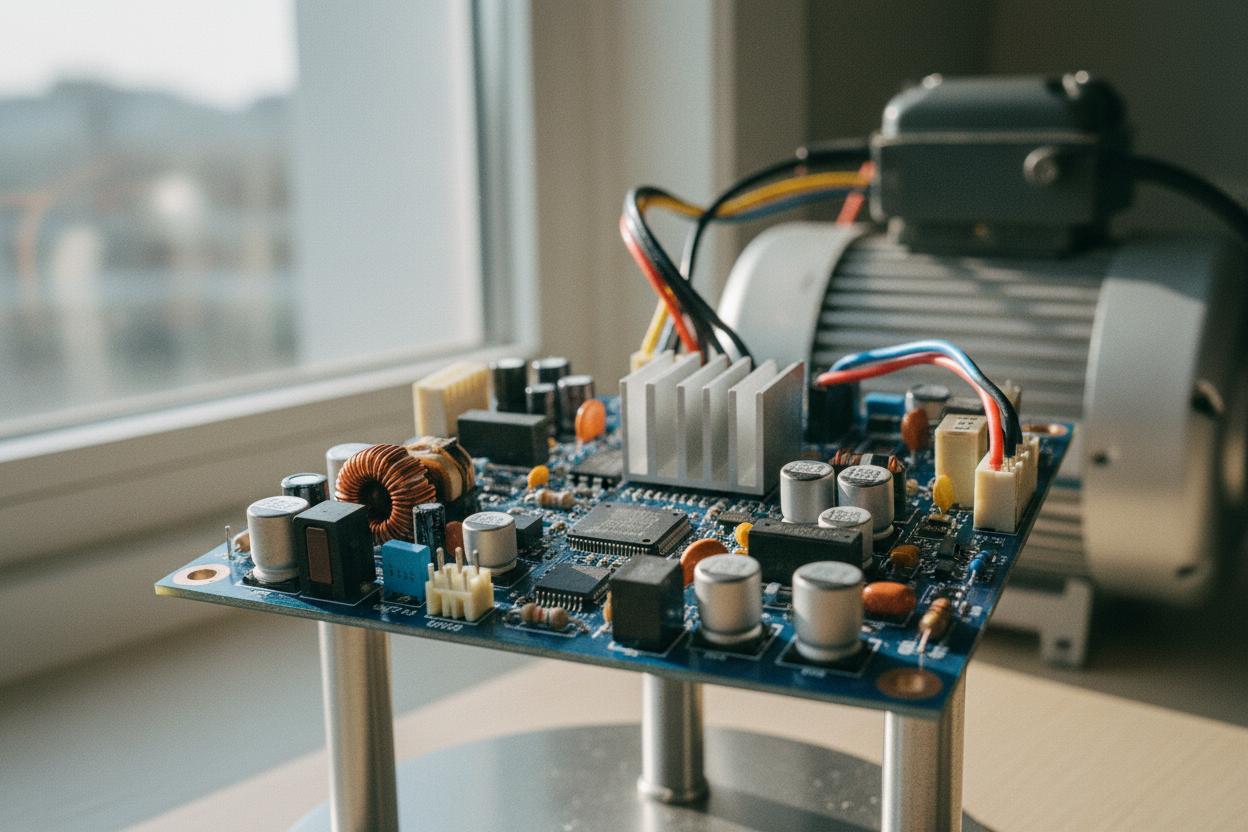
Choosing the Right Motor–Driver Pair — The character of motion is largely determined by the motor type and its driver topology. Brushed DC motors pair naturally with an H-bridge for bidirectional control and simple PWM speed regulation, making them approachable yet capable when paired with current feedback. BLDC motors need coordinated commutation via Hall sensors or estimation; six-step delivers simplicity, while sinusoidal or FOC control minimizes torque ripple for ultra-smooth results. Stepper motors, when driven with high-performance choppers and fine microstepping, achieve impressive positioning without encoders, though closed-loop steppers enhance torque utilization and stability under dynamic loads. High-power systems often rely on external gate drivers and discrete MOSFETs or IGBTs for thermal and efficiency margins, whereas integrated drivers reduce footprint and complexity. Match voltage, continuous and peak current, and thermal capability to the application profile. The better the pairing between motor physics and driver features, the easier it becomes to unlock stable, quiet, and precise motion in demanding motors applications.
Feedback, Control Loops, and Trajectories — At the heart of precision is the control loop. PID remains a versatile foundation, but the best results come from thoughtful add-ons: feedforward for velocity and acceleration, anti-windup to prevent integrator runaway, and notch or low-pass filters to suppress resonances and measurement noise. High-quality encoders, resolvers, or reliable Hall signals improve observability; sensorless estimators can work well when tuned and measured signals are clean. Smoothness is also a planning problem: use S-curve trajectories that limit jerk, and scale acceleration and velocity to match load inertia and compliance. Sampling rates, quantization, and latency shape loop stability, so align PWM frequency, control bandwidth, and measurement timing. For BLDC with FOC, field-oriented control decouples torque and flux (d and q axes), enabling fine torque control even at low speeds. Combine robust estimation, tuned gains, and intelligent trajectory generation to transform raw motor capability into confident, precise motion.
Power Stage, Layout, and Noise — The power stage turns theory into torque. Choose low-loss MOSFETs, appropriate gate resistors, and reliable dead time to prevent shoot-through, then stabilize switching with snubbers and tight decoupling near the H-bridge or inverter. PCB layout is critical: minimize loop areas, separate power and logic grounds with a clean star reference, and route high di/dt paths compactly to curb EMI and ringing. Thermal performance shapes reliability, so use adequate heat sinking, thermal vias, and airflow; verify junction temperatures under worst-case duty. Select a switching frequency that balances acoustic noise, current ripple, and efficiency. For smoothness, reduce torque ripple by shaping phase currents — FOC provides near-sinusoidal currents in BLDC, while microstepping does similarly for steppers. Shield and twist motor leads, consider common-mode chokes, and sample currents with low-inductance shunts or Hall sensors. A clean, efficient power stage preserves loop stability and elevates the quality of motion for all motors.
Integration Tips and Reliability — Great motion systems are engineered as a whole. Start with load inertia, friction, and compliance, then size motor, gear ratio, and supply voltage for the required speed–torque envelope with current headroom. Align driver ratings to continuous and peak demands, and include overcurrent, thermal shutdown, and undervoltage lockout for protection. Plan regenerative braking paths or a dump resistor to handle energy during deceleration. Implement robust homing, soft limits, and fault recovery, and structure firmware as clear state machines with deterministic update loops. Validate with step responses, Bode-style checks, and trajectory trials that exercise acceleration and jerk limits. Log telemetry — currents, temperatures, loop errors — to guide tuning and maintenance. Mechanically, use proper couplings, cable strain relief, and connectors rated for the environment. Electrically, manage grounding and shielding early. With disciplined integration, your controller–driver–motor stack delivers quiet, repeatable, and safe performance across a wide range of motors applications.